To Prev Page
IMES Newsletter: 2026 BoC-Philadelphia Fed-BOJ Joint Workshop

The Bank of Canada (BoC), the Bank of Japan (BOJ), and the Federal Reserve Bank of Philadelphia co-hosted a workshop at the Federal Reserve Bank of Philadelphia on September 18, 2026.
The workshop was initiated by the BoC and the BOJ in 2013, with the Federal Reserve Bank of Philadelphia joining in 2019, to promote research discussions and share latest policy-relevant research among participating central banks and academic researchers. This year, in the ninth edition of the workshop, two speakers were invited from academia: Professor Pablo Guerrón (Boston College) and Professor Toshihiko Mukoyama (Georgetown University).
From among the papers presented at the workshop, this newsletter summarizes four papers that address a wide range of issues, including the credit and retail price implications of credit card payments, the effect of fiscal transfers on inflation, and the macroeconomic implications of population decline and the limits of human rationality.(1)
1. Credit Effects of Credit Card Interchange Fees

In the United States, credit cards are the main instrument of unsecured borrowing as well as a means of payments. On each card payment, the merchant pays a fee whose major portion goes to the cardholder's bank as the interchange fee. This fee is then used as cardholder rewards, such as cash back and points, or retained by the bank. What are the effects of rewards and interchange fees on credit card interest rates and limits, retail prices, and household welfare?
To address the question, Dr. Chatterjee (Philadelphia Fed) first used U.S. bank supervisory data (2) to document facts on contract terms, usage, and default rates for reward and non-reward cards.(3) He then built a heterogeneous-agent macroeconomic model with competitive credit-card and retail sectors, estimated it to match the facts, and used it to measure the effects of interchange fees on credit terms, retail prices, and household welfare.
He reported three main findings. First, in the data, reward cards carry higher credit limits, while non-reward cards carry lower interest rates despite higher default rates, the reverse of the usual relationship between credit risk and pricing. Second, in the model, rewards strengthen the incentive to repay because they are lost upon default, and the retained interchange fees are used for raising credit limits and lowering interest rates on non-reward cards, acting as a credit subsidy. Third, although interchange fees raise retail prices, they increase credit availability and decrease interest rates, so that the net welfare effect of current fee levels is positive for both reward and non-reward cardholders.
This research highlights the effects of interchange fees on credit terms. By focusing on the role of credit cards as both a payment and a credit instrument in a macroeconomic framework, the analysis offers a new perspective on payment, credit, and welfare.
2. Are Fiscal Transfers Inflationary?
In the early 2020s, U.S. inflation surged to levels not seen since the early 1980s, triggering a quest to understand its causes. Early discussions focused on pandemic-related fiscal measures and supply chain disruptions. The bulk of fiscal response consisted of transfers to households rather than government purchases. Yet much of the empirical literature on fiscal policy focused on government consumption and investment. Moreover, estimating the effects of fiscal transfer policy faces a challenge of accommodating both systematic and non-systematic fiscal policy shifts.
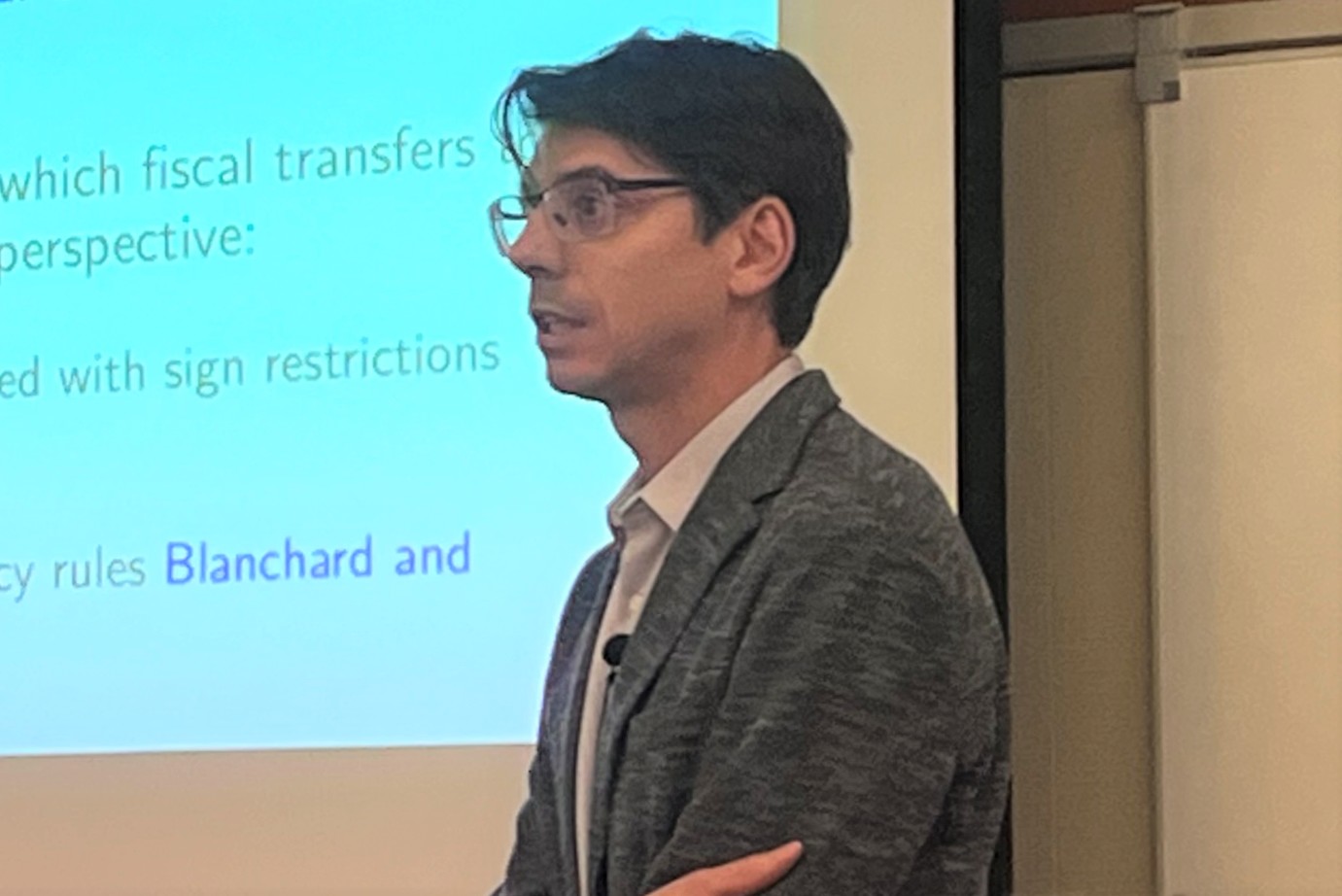
Thus motivated, Dr. Arias (Philadelphia Fed) presented an empirical approach to estimate the effect of fiscal transfer shocks on inflation.(4) The approach employs a time-varying structural vector autoregression (SVAR) to capture potential shifts in systematic and non-systematic fiscal transfer policy.(5) He estimated the model using U.S. data from 1953 to 2019, and conducted a historical decomposition to explain the inflation surge of 2021-2022.
He reported three main findings. First, a substantial part of the pandemic-era increase in transfers consisted of discretionary shocks, and these shocks contributed substantially to a rise in the price level through mid-2021. But the subsequent rise was driven mainly by adverse supply shocks such as supply-chain disruptions. Second, the magnitude of the price response depends on the systematic monetary policy reaction. The response was large during 2021-2022 because, in part, of accommodative monetary policy. Third, in the early 2020s, fiscal transfer shocks played a pivotal role in preventing a decline in output comparable to the one experienced during the Great Depression.
This research shows that fiscal transfers can involve a trade-off between supporting output and raising prices, and that their inflationary effect depends on how monetary policy responds to inflation. It also demonstrates the usefulness of time-varying SVARs for assessing the interaction between fiscal and monetary policy.
3. Bounded Rationality as Limited Optimization: Stochastic Gradient Descent Agents in Macroeconomic Models

Standard macroeconomic models assume that economic agents can solve high-dimensional nonlinear dynamic programs at negligible cost. But, in practice, agents' capacity to conduct exact optimization appears to be limited to some degree. How to model this bounded rationality remains an important challenge.
Professor Guerrón (Boston College) addressed the challenge by proposing a new equilibrium concept called a "stochastic gradient descent (SGD) equilibrium."(6) In this framework, agents are fully aware of their preferences and constraints and are fully informed about the economy, but they must make choices with limited computation capacity. Specifically, their decision rules are represented by neural networks, which they improve step by step using stochastic gradient descent, an algorithm widely used in machine learning. The limited computation capacity is captured by two things: a planning horizon, which governs how much of the future an agent takes into account, and the number of times the decision rule can be updated for reaching the optimum.
Applying this equilibrium concept to a real business cycle (RBC) model, he reported three main findings. First, as the planning horizon and the number of updates go to infinity, the SGD equilibrium converges to the rational expectations equilibrium. Second, when the planning horizon is short and updates are few, agents deviate systematically from rational expectations behavior; for instance, they save less than is optimal, leaving the economy with persistently low output. Third, these deviations show up as distortions, known as "wedges." In this model, the wedges arise endogenously, without financial frictions or non-productivity shocks, and vary with the state of the economy.
This research shows that limited optimization plays the role of a tractable, structural form of bounded rationality, offering a new way of solving complex macroeconomic models by simulation alone, without full optimization. Moreover, the research implies that heterogeneity in computation capacity gives rise to cross-sectional dispersion in behavior. The future agenda includes estimating computation capacity to understand agents' behavior and the economic dynamics.
4. Optimal Innovation under Population Decline: Growth and Firm Dynamics

Working-age population growth has been falling in many major economies. Demographic change can also affect firm entry, exit, and innovation, which are key sources of economic growth. Against this backdrop, how should firm dynamics and innovation adjust, and how should policy respond?
Professor Mukoyama (Georgetown University) first examined how working-age population growth relates to establishment entry rates, exit rates, and size growth, using U.S. state-level and Japanese prefecture-level data. He then built an endogenous growth model with three margins of innovation: the creation of new products, creative destruction that replaces existing products, and incumbents' improvement of their own products. Using the model, he compared the market equilibrium with the socially optimal allocation.(7)
He reported three main findings. First, in both the U.S. and Japan, entry comoves with working-age population growth, whereas the relationships with exit and size growth are less clear-cut. Second, in the model, slower population growth reduces entry and tilts innovation away from new entrants toward incumbents. Third, the market equilibrium has two distortions. One is business stealing, whereby entrants capture incumbents' profits, leading to excessive incentives for creative destruction and entry. The other is that firms discount future profits more heavily than is socially optimal, reflecting the risk that their products will be replaced, so they value innovation below its social value. The former can be corrected by taxes on creative destruction and entry, and the latter by a subsidy to profits. In the quantitative model, the latter distortion outweighs the former, so that, on balance, in the market equilibrium, innovation and entry fall far short of socially optimal levels. Moreover, slower population growth makes the latter distortion smaller, calling for a smaller subsidy for achieving socially optimal levels of innovation and entry.
This research disentangles the effects of slower population growth on innovation and unveils the mechanisms of how it affects innovations by incumbents and new entrants. The analysis offers valuable insights into the relationship between innovation policy and demographics for economies facing population decline, such as Japan.
* The titles and information in this newsletter are as of the time of the workshop.
Notes
Click on the number at the end of each item to return to the main text.
- In addition to the featured summaries, several other studies were presented. Youming Liu (BoC) delivered a report titled "From Loan to Loyalty: Deposit-Lending Synergy in Canadian Banks," and Christian Bustamante (BoC) presented "Founders and Their Heterogeneous Firms." From the BOJ, Daisuke Ikeda presented "Monetary-Fiscal Nexus and Unintended Equilibria," and Yojiro Ito presented "Supply Shocks and Inflationary Pressures in Global Value Chains: The Role of Network Centrality." (1)
- The FR Y-14M report, which large U.S. banks submit to the Federal Reserve. Collection began after the global financial crisis in order to assess the riskiness of bank portfolios, and the data include account-level information on credit card limits, interest rates, balances, and delinquencies. (2)
- Chatterjee, S. and B. Eyigungor. 2026. "Credit Effects of Credit Card Interchange Fees," mimeo. (3)
- Arias, J. E., J. F. Rubio-Ramirez, and M. Shin. 2026. "Are Fiscal Transfers Inflationary?" Working Papers 26-23, Federal Reserve Bank of Philadelphia. (available at https://www.philadelphiafed.org/the-economy/monetary-policy/are-fiscal-transfers-inflationary ) (4)
- A vector autoregression (VAR) describes the joint dynamics of several economic variables; a structural VAR imposes theory-based restrictions on the relationships among them so that the effects of individual shocks can be isolated. This study allows those relationships to change over time while imposing restrictions that identify fiscal transfer shocks. (5)
- Guerrón Quintana, P. A. 2026. "Bounded Rationality as Limited Optimization: Stochastic Gradient Descent Agents in Macroeconomic Models," Boston College Working Papers in Economics 1110, Boston College Department of Economics. (available at https://ideas.repec.org/p/boc/bocoec/1110.html ) (6)
- Chang, M. and T. Mukoyama. 2026. "Optimal Innovation under Population Decline: Growth and Firm Dynamics," mimeo. (7)
Reference
The newsletter of the past "Bank of Canada, Federal Reserve Bank of Philadelphia, and Bank of Japan Joint Workshop"