To Prev Page
IMES Newsletter: 2025 Finance Workshop
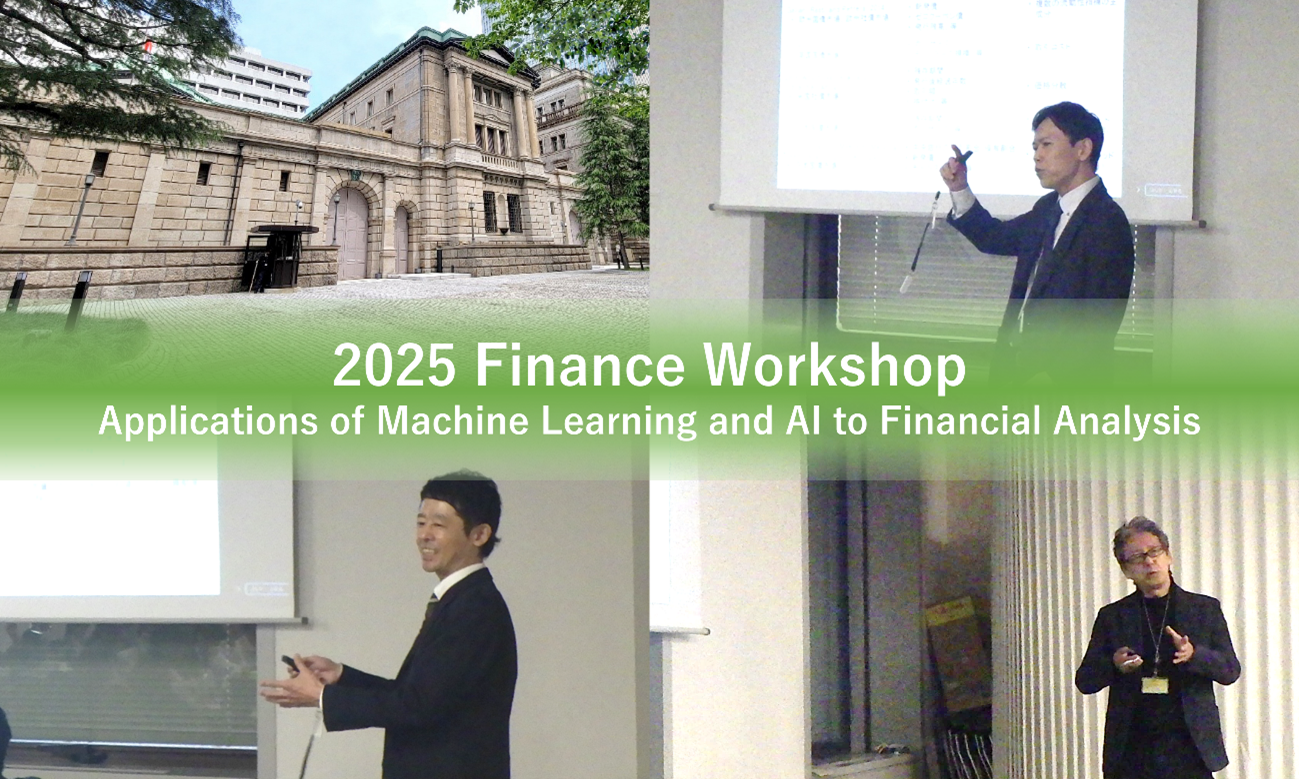
The Institute for Monetary and Economic Studies (IMES) of the Bank of Japan (BOJ) held the Finance Workshop on November 28, 2025, in a hybrid format. In this 11th edition of the workshop, three research presentations were delivered under the theme "Applications of Machine Learning and AI to Financial Analysis."
- 1. Opening Remarks
- 2. The Determinants of Liquidity in the Japanese Government Bond (JGB) Markets
- 3. Explaining Cross-Sectional Stock Returns Using SHAP and Other Machine Learning Interpretation
- 4. From Words to Returns: Sentiment Analysis of Japanese 10-K Reports Using Advanced Large Language Models
- 5. Closing Remarks
- 【References】
1. Opening Remarks
Shingo Watanabe (Director-General, IMES) noted that machine learning and AI technologies have been utilized in the field of finance from an early stage, and highlighted that these topics have been discussed multiple times in the previous editions of the Finance Workshop. He also pointed out that AI technologies, including Large Language Models (LLMs), have made remarkable progress since then. In conclusion, he expressed his hope that discussions on the application of these technologies to financial analysis would be further explored from a wide range of perspectives.
2. The Determinants of Liquidity in the Japanese Government Bond (JGB) Markets
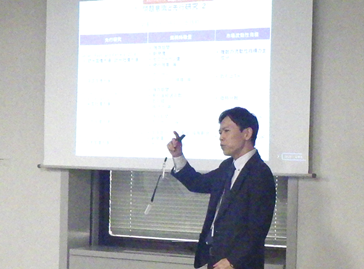
Toshiyuki Sakiyama (IMES) began by noting that there had been significant fluctuations in government bond yields globally, which had drawn increasing attention to the liquidity of government bond markets. He mentioned that in Japan, the prolonged negative interest rate policy ended in 2024, followed by subsequent increases in policy rates. He emphasized the importance of carefully investigating liquidity in the changing environment surrounding the JGB markets.
Thus motivated, he constructed a wide range of factors—referred to as bond features—that could influence the liquidity of government bond markets, drawing on previous studies. Collaborating with Satoko Kojima (IMES), he investigated the relationship between these factors and market liquidity using machine learning techniques.
The analysis revealed that the share of transactions conducted by foreign financial institutions, which is one of the bond features, exhibited a non-linear relationship with market liquidity: liquidity improved as the share increased, but it deteriorated once the share exceeded a certain threshold. He noted that similar relationships were observed not only for the share but also for other bond features, such as the share of central bank holdings and the number of trading financial institutions. Additionally, he pointed out that, since around 2022, various bond features have influenced market liquidity. Finally, based on these findings, he emphasized the importance of constructing a variety of bond features using high-granularity data and applying machine learning techniques capable of capturing complex relationships to thoroughly investigate the relationships between market liquidity and bond features.
The discussant, Professor Keiichi Goshima (Yokohama National University), noted that this study was the first comprehensive analysis of the determinants of liquidity in the JGB markets using high-granularity data at the individual bond level. He highlighted that the study provided valuable new insights into market liquidity. He then proposed several directions for further analyses, including incorporating a broader range of bond characteristics in the data selection, segmenting the analysis period to investigate structural changes, and comparing results derived from machine learning techniques with those obtained from linear regression models. He emphasized that these further analyses would promote deeper understanding of liquidity in the JGB markets.
3. Explaining Cross-Sectional Stock Returns Using SHAP and Other Machine Learning Interpretation
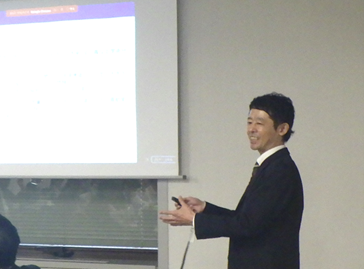
Professor Junnosuke Shino (Waseda University) explained the rapid increase in the adoption of SHAP (SHapley Additive exPlanations), a method for visualizing the results of machine learning analyses. He then discussed the challenges of SHAP and proposed new alternative methods aimed at addressing the challenges. Furthermore, he applied both SHAP and the proposed methods to the analysis of stock returns of Japanese companies. This study is a joint work with Kazuhiro Hiraki (International Monetary Fund).
Professor Shino first explained that SHAP was based on a solution concept called the Shapley value, which originated from the perspective of cooperative game theory, referring to the work of Lundberg and Lee [2017] (Reference 1). He then noted that there were many solution concepts in cooperative game theory besides the Shapley value and proposed alternative methods based on these solution concepts. In particular, he examined alternative methods derived from the equal surplus division value and its related solution concepts, as opposed to the Shapley value. He showed that, while the computational cost of using SHAP increased exponentially with the number of features used in the analysis, the computational cost of using these alternative methods increased only linearly, leading to a significant reduction in computational costs.
Next, he applied these visualization methods to the analysis of stock returns of Japanese companies. He argued that, because there was no significant difference in the results visualized using SHAP and the alternative methods, the proposed alternatives could maintain high accuracy while reducing computational costs. Furthermore, he conducted the analysis by incorporating the amount of ETFs purchased by the Bank of Japan as an additional feature and reported the possibility of non-linearity in its effect on stock returns.
The discussant, Professor Kiyoshi Izumi (University of Tokyo), mentioned that with the increasing adoption of LLMs in recent years, there was growing interest in the transparency and reliability of machine learning analyses. He emphasized that, as a result, research on XAI (eXplainable AI), which facilitates the interpretation of results from machine learning analyses, including SHAP, was gaining importance. Within this context, he highlighted that this study possessed remarkable novelty and originality compared to previous XAI research, as it developed alternative methods based on the fundamental definitions of solution concepts in cooperative game theory. In addition, he highly appreciated the study's effort to address the challenge of computational costs associated with using SHAP, a frequently discussed topic at recent international workshops. Regarding the future course of research, he pointed out the importance of applying the alternative methods to situations with a large number of features or strong relationships among features in order to gain a deeper understanding of their characteristics.
4. From Words to Returns: Sentiment Analysis of Japanese 10-K Reports Using Advanced Large Language Models

Professor Katsuhiko Okada (Kwansei Gakuin University) began by stating that while various factors have been reported as sources of excess stock returns in the field of finance, this study explored whether a new source of excess returns can be found in text information. This study is a joint work with Moe Nakasuji, Yasutomo Tsukioka (both Kwansei Gakuin University), and Takahiro Yamasaki (Osaka Sangyo University).
He first created a sentiment index using the Annual Securities Reports for each Japanese company. Next, he constructed a portfolio by taking long positions in the group with high index values and short positions in the group with low index values, and measured the excess returns of the portfolio over the subsequent year. In creating the sentiment indices, he used both polarity dictionaries and LLMs. Regarding LLMs, he employed a BERT model fine-tuned on Japanese Annual Securities Reports, as well as pre-trained LLMs such as ChatGPT, Claude, and Gemini. He then constructed five portfolios corresponding to the sentiment indices created by these five methods.
The results showed that excess returns were obtained from the portfolio corresponding to sentiment indices created by pre-trained LLMs. In contrast, he reported that such excess returns were not observed when using sentiment indices created by polarity dictionaries or the fine-tuned BERT model. Based on these results, he argued that pre-trained LLMs had the potential to predict reactions in the Japanese stock markets by analyzing Annual Securities Reports, as pre-trained LLMs possess strong contextual understanding capabilities.
The discussant, Professor Kei Nakagawa (Osaka Metropolitan University), stated that this study was one of the few studies that analyze the relationship between sentiment and asset prices in the Japanese financial markets in the long run and at large scale. He highly appreciated the study for its thoroughness and academic contribution, particularly its provision of detailed information on highly reproducible code and data. He then pointed out that various biases have been reported in LLMs, such as a bias toward generating answers favorable to users. Regarding the future direction of research, he argued that it would be important to deepen understanding of the effects of biases on sentiment indices by examining the distribution of sentiment indices and the relationship between sentiment indices and company attributes, and by using year-on-year differences in sentiment indices.
5. Closing Remarks
Koji Nakamura (Executive Director, BOJ) reflected on today's workshop, stating that all the studies made effective use of the strengths of AI and machine learning, particularly their ability to process large volumes of data in a short amount of time and uncover underlying patterns. He then expressed his expectation that the discovery of previously unimagined use cases would lead to applications in new research and practical fields, as AI technologies, including LLMs, continue to advance.
Finally, he noted that IMES has been conducting AI-related research not only in the field of finance but also in diverse areas such as economics, DX, and law. He concluded his remarks by emphasizing the importance of fostering collaboration with academics and practitioners to further deepen discussions on advancing AI utilization.
The affiliations and titles listed here are as of the time of this workshop.
【References】
Click on the number at the end of the document to return to the main text.
- Lundberg, Scott M., and Su-In Lee, “A Unified Approach to Interpreting Model Predictions,” Advances in Neural Information Processing Systems, 30, 2017, pp.4765-4774. (1)